
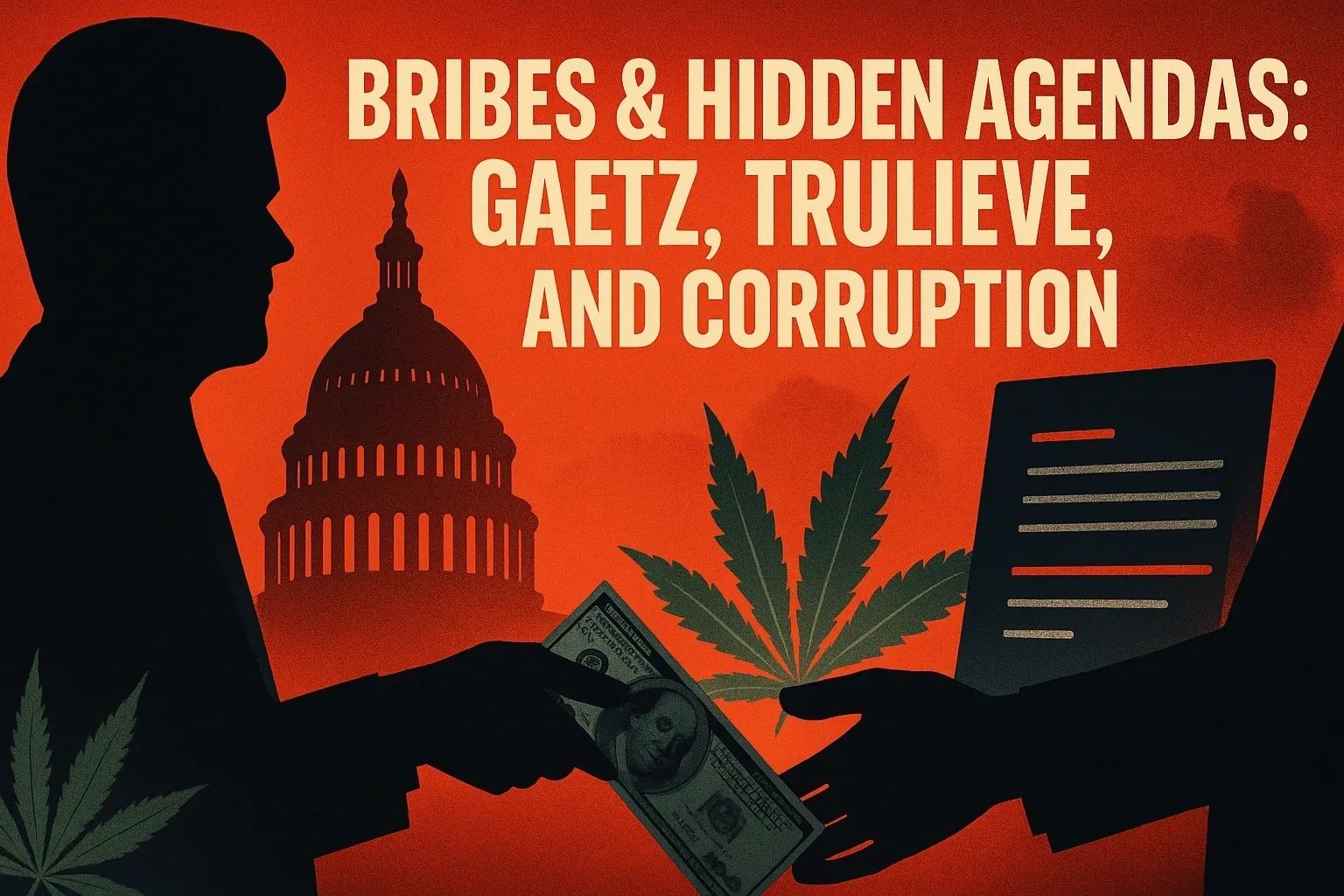
Bribes & Hidden Agendas: Matt Gaetz, Trulieve, and Corruption
Investigative Journalism by illest haze ## Gaetz’s $2 Million “Green” Contract Exposed Matt Gaetz could use a privacy screen. A TikTok user on a flight snapped a photo of the former Congressman’s laptop, revealing a contract offer involving Florida cannabis giant Trulieve . The file, titled “Pui
Investigative Journalism by illest haze
Gaetz’s $2 Million “Green” Contract Exposed
Matt Gaetz could use a privacy screen. A TikTok user on a flight snapped a photo of the former Congressman’s laptop, revealing a contract offer involving Florida cannabis giant Trulieve . The file, titled “Puig Of Counsel Agreement – LP,”shows Gaetz poised to provide “legal representation, consulting [and] administration-related guidance” to a firm affiliated with Trulieve . In exchange, Gaetz would be paid handsomely: $250,000 if a certain “MATTER” is resolved, plus an “additional ‘Super Success Fee’” for achieving “exclusive policy remedies” . The screenshot cuts off the exact bonus, but reports suggest it reads “$2,000,000” – a staggering sum for a cannabis lobbying win .
The context is startling. Gaetz – a MAGA firebrand and Trump loyalist – appears to have been offered over $2 million to leverage his Trumpworld contacts on Trulieve’s behalf . The leaked image was posted by the TikTok user in the comments of her video with the caption, “Gigantic font. No privacy screen on his phone, NOR ON HIS LAPTOP.” Gaetz himself tacitly confirmed the leak, tweeting that someone recorded him texting his mother and working on his laptop, quipping, “maybe get a screen…” . He did not deny the contract’s authenticity. Neither Gaetz nor Trulieve responded to press inquiries about the agreement .
What exactly is this “matter” Gaetz would resolve? The contract doesn’t say, but timing is everything. With Donald Trump back in the White House after the 2024 election and a major federal cannabis decision looming, industry insiders suspect the “matter” refers to federal marijuana policy changes – possibly rescheduling cannabis from Schedule I to Schedule III, or other favorable regulatory moves . The deal explicitly mentions “administration-related guidance,”hinting that Gaetz’s close ties to Trump are the prize asset. Indeed, Trump had floated Gaetz as a potential Attorney General pick – a prospect derailed only by Gaetz’s personal scandals . Now, as a private citizen, Gaetz was free to cash in on those connections. The Daily Beast dryly noted that the contract “highlights the potential for individuals close to Trump to cash in on their relationship with him.”
Gaetz and Trulieve: Cozy Ties or Corrupt Alliance?
Gaetz’s emergence as a cannabis industry fixer didn’t come out of nowhere. During his political career, Gaetz was one of the few pro-cannabis Republicans. As a Florida state legislator, he sponsored the 2014 bill that legalized medical marijuana – but also helped limit the number of licenses, creating a tightly controlled market . That law’s narrow criteria (favoring established nurseries and insiders) drew criticism for enabling a “green rush” for well-connected players. Indeed, Trulieve – now Florida’s largest cannabis operator – traces its origins to a nexus of prominent Florida Republicans close to Gaetz . One early Trulieve board member, Thad Beshears, was a college friend of Gaetz and brother of a Florida official who joined Gaetz on a now-infamous 2018 Bahamas trip under federal investigation . Project CBD reported that investigators probed whether a cannabis entrepreneur on that trip “sought to influence state legislation Gaetz sponsored.”
In Congress, Gaetz burnished his weed-friendly credentials. He co-sponsored the federal MORE Act to deschedule marijuana and expunge convictions, and wrote a March 2025 op-ed urging that cannabis be moved from Schedule I (alongside heroin) to Schedule III . At the time, Gaetz cast rescheduling as common-sense reform for patients and veterans – with no disclosure that Trulieve or any cannabis company might stand to benefit . (He declared no industry ties in that op-ed, and there’s no suggestion he was on Trulieve’s payroll then .) But in retrospect, the op-ed aligns neatly with Trulieve’s agenda. The company has aggressively lobbied for federal reforms, from rescheduling to banking access . Trulieve even poured tens of millions into a 2024 Florida ballot initiative to legalize recreational marijuana (Amendment 3) – a measure Trump surprisingly endorsed after meeting Trulieve CEO Kim Rivers, though Gaetz himself withheld support .
All these threads paint a picture of mutual courtship. Trulieve, valued around $660 million , stood to gain immensely from a friend in Trump’s inner circle. Gaetz, whose political star had dimmed under ethics investigations, stood to make a fortune by delivering results for Trulieve. It’s a classic Washington tango: a revolving-door politician and a deep-pocketed corporation finding each other at the intersection of money and influence. Ethics watchdogs would call this exactly what it looks like – a pay-to-play arrangement, if not an outright bribe. Gaetz might brand it as consulting, but the line between consulting and corruption blurs when a politician is promised a “Super Success” bounty for swaying policy.
Quid Pro Quo, or ‘Just Business’ as Usual?
Gaetz’s leaked contract raises a blunt question: Is this a quid pro quo? In plainer terms, is a major cannabis company offering him money to influence a government decision? Gaetz is no longer in office, so the legal strictures are looser than for an active lawmaker, but the arrangement is drawing fire as a stark example of the cash-for-favors culture surrounding cannabis policy. “You can’t trade on your office, embrace a corrupt pay-to-play culture, and get away with it,” warned the FBI’s Boston chief after busting a different marijuana bribery scheme . The principle rings true here. Gaetz’s case may not involve a literal suitcase of cash slid under a table, but the principle – money offered explicitly for political influence – smacks of a quid pro quo in all but name.
Government ethics experts note that even if Gaetz’s deal skirts legality by occurring after his resignation, it reeks of impropriety. “Everyone working their way towards getting a piece of the action” is how one policy expert described the atmosphere when lucrative cannabis licenses or laws are on the line . Gaetz, with his outsized influence in Trumpworld, is a man who can deliver a very big “piece of the action.” The Daily Beast observed that for Gaetz, “‘guiding DJT’ [Donald J. Trump] could be lucrative.” Indeed, the leaked document explicitly ties Gaetz’s payday to policy outcomes – a contingency that is the hallmark of a quid pro quo. If Trump’s administration (or Gaetz whispering in Trump’s ear) were to, say, fast-track rescheduling of cannabis, Gaetz would apparently unlock that seven-figure Super Success Fee .
It’s an ethical gray zone at best. Federal anti-corruption statutes usually target bribes to public officials; Gaetz as a private lobbyist-for-hire might not violate law unless he explicitly promises official action in return. But the spirit of anti-corruption laws is clearly in jeopardy when a former Congressman monetizes insider access to engineer specific government favors. “They cheated, and they put at a disadvantage those people who followed the rules,” said U.S. Attorney Mark Totten in a related case of cannabis corruption . Swap out the names, and that quote could apply here: if Trulieve can essentially buy itself a federal policy change while ordinary advocates have only their voices and votes, the playing field is beyond tilted – it’s corrupted.
A Pattern of Corruption in the Cannabis Industry
The Gaetz-Trulieve saga is sensational, but not singular. Across the United States, the rapid growth of the cannabis and hemp industry has been accompanied by a rash of bribery, influence-peddling, and regulatory capture. Federal authorities and watchdog groups have been sounding the alarm. “For years, the FBI has been warning states about the threat of public corruption posed by the cannabis industry,” POLITICO reported in 2023 . The reason is simple: where licenses and laws can make millionaires overnight, unscrupulous players will pay to play. Below are just a few recent examples that reveal how deep the rot can go:
These cases span coast to coast. In California, a sprawling FBI investigation has ensnared local officials from suburban Los Angeles for taking payoffs to award cannabis permits . In one brazen episode, two city officials in Calexico were busted after soliciting cash from an undercover agent to fast-track a dispensary license – one official even boasted, “This isn’t our first rodeo,” as they arranged the $35,000 payoff . In Missouri and Arkansas, state lawmakers and consultants have been accused of skewing merit-based licensing in favor of insiders, prompting legislative probes and public outrage. And at the federal level, corruption has crept in through campaign finance. In 2019, two associates of Rudy Giuliani (Lev Parnas and Igor Fruman) were indicted for a scheme to funnel foreign money into U.S. campaigns to influence cannabis licensing, among other favors . The pattern is unmistakable: wherever cannabis markets are worth billions but tightly controlled by government gatekeepers, a black market of political favors emerges.
Why is the cannabis sector so prone to corruption? Part of the answer lies in the patchwork of state laws and the lingering federal prohibition. The demand for licenses (to cultivate, process, or sell legal cannabis) far exceeds the supply, and often a small group of officials has vast discretion in doling out those lucrative permits . “The state is given full control in an industry where everyone realizes how valuable these licenses are,” observes one industry consultant, describing how disappointed applicants in Missouri suspected the process was rigged . The high stakes and limited licenses create fertile ground for bribery: if a license is a golden ticket, some will pay a golden price under the table to get it. Similarly, on the legislative side, as public opinion swings toward legalization, politicians hold the keys to reform – and deep-pocketed companies try to write the laws in their favor, or block laws that hurt them, often via hefty campaign contributions or cushy job offers.
The Price of Swaying Laws and Licenses
The influence of financial incentives in shaping cannabis policy cannot be overstated. Lawmakers and regulators, from city halls to Congress, have been courted by the green wave of cannabis dollars. In state capitols, lobbyists for multi-state cannabis corporations swarm to bend rules their way. In Washington, D.C., cannabis business coalitions and executives are now major political donors. Money talks – and in the cannabis world, it’s sometimes practically shouting.
Consider Florida: Trulieve pays top lobbyists like Ballard Partners $160,000 a year to champion its interests in Tallahassee . The company’s co-founder, Kim Rivers, has cultivated GOP allies – even meeting with Donald Trump during his campaign to discuss cannabis. Shortly after that meeting, Trump stunned observers by endorsing Florida’s legalization referendum and calling for rescheduling cannabis, positions Trulieve fervently desired . At the national level, Trump’s inaugural committee raked in at least $1 million from the marijuana industry, including $750,000 from Trulieve and another $250,000 from Curaleaf (the nation’s largest cannabis firm) funneled through an industry group . Those contributions bought access and goodwill; whether they directly swayed policy is hard to prove, but the timing and outcomes raise eyebrows. Trump, once a sporadic supporter of legalization, began styling himself as a “weed champion”who would support states’ rights and cannabis banking reforms . Quid pro quo or not, the optics of donation-driven conversion are impossible to ignore.
In state legislatures, cannabis companies have dangled investments and donations to influence bills. Some scenarios are unapologetically transactional – as when Maryland’s Cheryl Glenn literally had a price list for legislative favors (a few thousand dollars to file a bill, more to ensure it passed) . In other cases, the corruption is couched in the polite terms of lobbying and campaign support, but the effect is similar. A 2020 Politico investigation found that in multiple states, well-heeled marijuana firms offered extra “community benefits” or side deals to localities to secure licenses, skirting legal limits . For example, a national dispensary chain in Massachusetts quietly offered a town funds for police details, arts programs, and festivals in hopes of winning a license – effectively outbidding smaller competitors with civic donations. This arms race of generosity may not be illegal, but regulators worry it undermines equity and transparency, favoring those with the deepest pockets.
The hemp side of the industry isn’t immune either. The explosion of hemp-derived THC products in the grey market has seen intense lobbying fights at state levels, as companies use political donations to push for favorable definitions of what’s legal hemp versus illegal marijuana. While not as widely reported as the marijuana cases, the pattern of pay-to-play lobbying extends to any cannabinoid product with profits at stake.
All of this suggests a sobering reality: cannabis legalization, a movement once rooted in social justice and compassion, has also given rise to a new breed of crony capitalism. Big Cannabis, like Big Tobacco or Big Pharma before it, knows how to spend money to get its way. And politicians, alas, often respond to those incentives. “The people of Massachusetts deserve a government that isn’t for sale,” said an FBI agent after busting Mayor Correia’s scheme . The same is true in every state: without strong safeguards, the promise of cannabis reform – from freeing non-violent prisoners to uplifting communities ravaged by the drug war – can be perverted by greed and graft.
Cleaning Up the Smoke
The urgent question now is how to respond to these revelations. Advocates argue that sunlight is the best disinfectant: stronger transparency laws on lobbying and campaign contributions can expose who is bankrolling whom. Some states are revisiting their licensing processes, moving from opaque commissions to merit-based or lottery systems to reduce opportunities for bribery. Others, like Michigan, simply abolished cumbersome licensing boards after scandals, moving oversight into standard agencies . There are calls to impose longer “cooling-off” periods before ex-lawmakers like Gaetz can waltz into industry jobs – to prevent the revolving door from spinning quite so freely.
At the federal level, the ethics of influence-peddling in cannabis (and hemp) need scrutiny. Gaetz’s case, if nothing else, should spark an inquiry: Was he negotiating this mega-deal while still in Congress, or using any non-public information? The House Ethics Committee and DOJ have shown willingness before to investigate corrupt agreements even after an official leaves office. And if Trump’s administration were indeed lobbied by Gaetz on Trulieve’s behalf, did it alter any policy decisions? These questions demand answers, if only to deter future officials from following Gaetz’s example of turning public service into a personal goldmine.
Meanwhile, industry leaders who truly believe in a fair, legal market must distance themselves from bad actors. Every scandal is a setback for legalization’s credibility. “We do not campaign, we do not run for office. We prosecute public corruption without fear or favor,” a U.S. Attorney said after convicting the Fall River mayor . That vigilance is essential if the “Wild West” of weed is to be tamed. As legalization continues to spread, more money will pour into politics – it’s inevitable. The challenge is ensuring that cannabis policy is decided on the merits – health, safety, justice – and not auctioned off to the highest bidder.
In the end, the leaked Gaetz-Trulieve deal is a clarion call. It lays bare the dirty underbelly of the Green Rush, where shadowy contracts and whispered promises threaten to derail the integrity of democratic decision-making. But exposing the scheme is the first step in stopping it. As reform advocate Shaleen Title once noted, acknowledging mistakes in the system allows us to fix them . The cannabis industry is at a crossroads: it can either clean up its act and live up to the ideals of transparency and equity – or continue down a path where cannabis legalization becomes just another story of money, power, and corruption. The stakes are high, and the nation is watching.
Sources:
• Miami New Times – “Matt Gaetz Accidentally Leaks Cannabis Contract with Trulieve”
• The Daily Beast – “Matt Gaetz Accidentally Reveals Lucrative Trump-Whispering Weed Deal”
• Marijuana Moment – “Gaetz Reviewing Contract to Provide Marijuana Company ‘Administration-Related’ Support”
• Politico – “Former Michigan Speaker Charged with Bribes for Cannabis Licenses”
• AP News – “2 lobbyists sent to prison for Michigan marijuana bribery scheme”
• U.S. DOJ (Massachusetts) – Press Release on Fall River Mayor Jasiel Correia Conviction
• Politico – “How state marijuana legalization became a boon for corruption”
• Los Angeles Times – “California lawmaker questioned in cannabis bribery scheme”
• Project CBD – “Cannabis & Crony Capitalism: From Matt Gaetz to Trulieve”
• Twitter – Matt Gaetz (@mattgaetz), June 24, 2025
 2026
2026 2026
2026 2026
2026