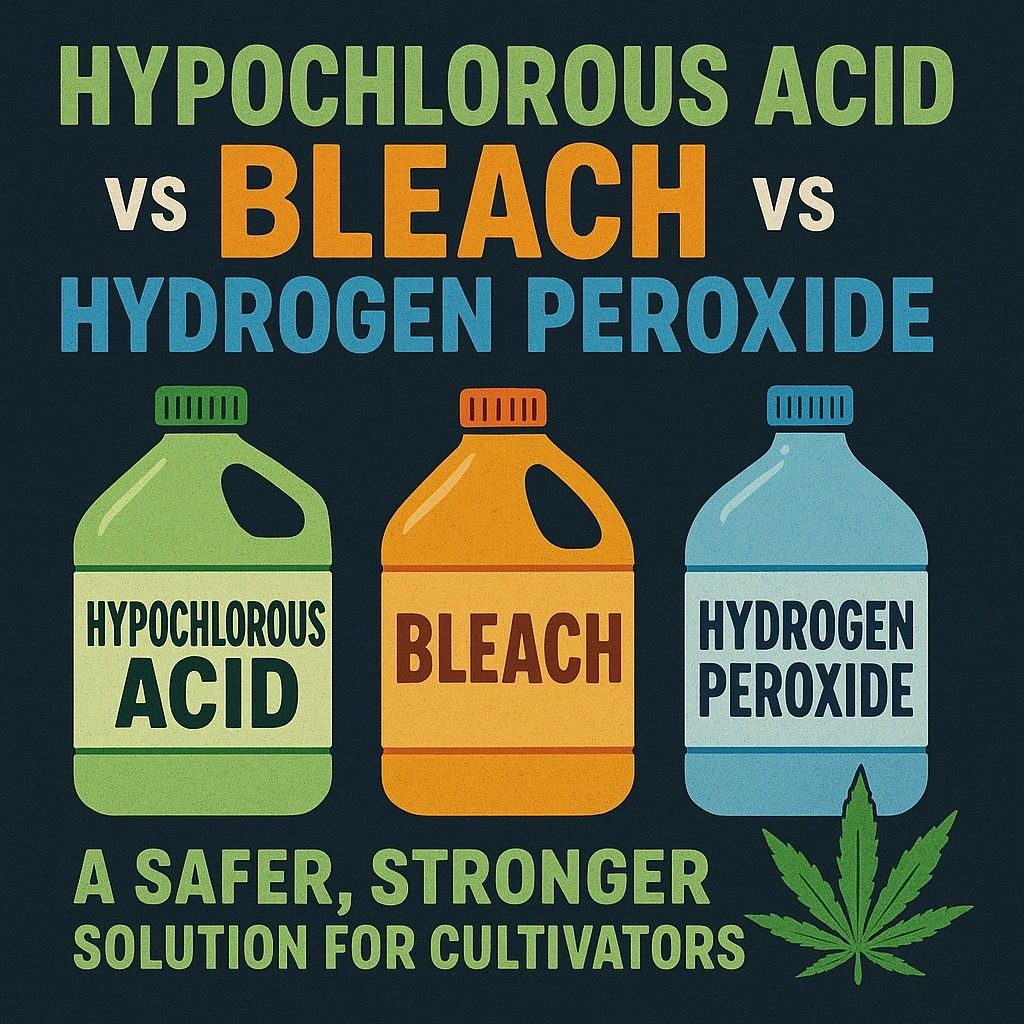
Hypochlorous Acid vs Bleach vs H2O2: A Safer, Stronger Solution
## Introduction Cultivators have long relied on harsh chemicals like bleach (sodium hypochlorite) and hydrogen peroxide (H₂O₂) to disinfect grow rooms and combat mold or pathogens. However, hypochlorous acid (HOCl) is emerging as a game-changing alternative – it’s up to 100–300 times more effecti
Introduction
Cultivators have long relied on harsh chemicals like bleach (sodium hypochlorite) and hydrogen peroxide (H₂O₂) to disinfect grow rooms and combat mold or pathogens. However, hypochlorous acid (HOCl) is emerging as a game-changing alternative – it’s up to 100–300 times more effective at killing microbes than bleach yet is non-toxic and safe on skin . Hypochlorous acid is so gentle you can literally spray it on your eyes or skin without harm, yet it rapidly oxidizes and destroys bacteria, fungi, and viruses even better than traditional disinfectants . This article will compare HOCl with bleach and H₂O₂, explain why HOCl’s superior kill power and safety make it an ideal disinfectant (especially in cannabis cultivation), and provide protocols and tips for using HOCl in your grow. We’ll also cover why bleach is still common despite HOCl’s advantages, and how cultivators can easily generate hypochlorous acid on-site with just salt and water. All claims are backed by scientific references and real studies to ensure accuracy.
What is Hypochlorous Acid (HOCl)?
Hypochlorous acid is a weak, chlorine-based acid (chemical formula HOCl) that exists in a near-neutral pH form (around pH 5.5–6.5) . It should not be confused with sodium hypochlorite (NaOCl), the active ingredient in bleach, which is a strongly basic solution (pH ~12) and very caustic . When bleach is dissolved in water, it partially converts to hypochlorous acid, but only a small fraction does so because bleach’s high pH keeps most of the chlorine as hypochlorite ions (OCl⁻) . In contrast, an HOCl solution is formulated at a lower, stable pH so that the majority of the chlorine is in the form of hypochlorous acid, not hypochlorite . This distinction is crucial: HOCl is the most potent disinfecting form of chlorine, whereas OCl⁻ (found in bleach) is far less effective at equivalent concentrations .
Biologically, hypochlorous acid is not a new or foreign chemical – it’s actually produced inside the human body by our own immune cells. When your white blood cells (neutrophils) attack invading pathogens, they generate HOCl as a weapon to oxidize and destroy bacteria and viruses within milliseconds . This natural origin helps explain why HOCl is so non-toxic to us (our bodies evolved with it) while being lethal to microbes. In fact, HOCl has been used medically for over a century: it was a go-to wound antiseptic in World War I, where soldiers treated with HOCl healed faster and experienced fewer infections than those treated with bleach solutions . The World Health Organization lists HOCl as an essential medicine, and regulatory agencies have approved it for a variety of sensitive uses: it’s FDA-approved to sanitize food contact surfaces and even fresh produce, used in wound care products, and EPA-approved as a surface disinfectant (including for SARS-CoV-2 virus) . In short, hypochlorous acid is a well-established disinfectant that is extremely effective against microbes yet safe enough to use on food, skin, and in medical settings .
So why isn’t HOCl a household name? The main historical challenge was stability. Pure HOCl in solution is highly unstable and tends to revert to ordinary saltwater if not kept in just the right conditions . It remains potent only in a narrow pH range (roughly 4–6) and degrades within minutes to days when exposed to light or air . For decades, this made it difficult to bottle and sell HOCl as a consumer product – by the time it sat on a store shelf, it would lose strength. Bleach (sodium hypochlorite), on the other hand, while not as powerful a disinfectant, has a longer shelf life and thus became the default chlorinated cleaner sold worldwide. However, modern technology has solved the stability issue: today, HOCl can be generated on demand by electrolysis of salt and water, or produced in stabilized formulations. This means we can now harness HOCl’s full power in practical ways, which is why it’s “trending” again as a cleaning and sanitizing agent . In the next sections, we’ll compare how HOCl stacks up against bleach and hydrogen peroxide in terms of germ-killing efficacy and safety.
Efficacy Comparison: Kill Power and Speed
Hypochlorous acid vs Bleach: HOCl is widely documented to be far more effective at killing pathogens than bleach (sodium hypochlorite), especially at equivalent available chlorine concentrations. The scientific reason is that HOCl carries a neutral electrical charge, so it easily penetrates microbial cell walls, whereas the hypochlorite ion (OCl⁻) from bleach is negatively charged and gets repelled by the negatively charged cell surfaces . Multiple studies have found that HOCl can be 80–100 times more efficacious than OCl⁻ at killing bacteria and other pathogens . In practical terms, this means a relatively low concentration of HOCl can achieve the same or better disinfection than a much higher concentration of bleach. For example, a pure HOCl solution at only 150 ppm (parts per million) active chlorine can match the disinfecting power of a 500 ppm bleach solution . One product test reported that HOCl at 150 ppm killed germs in under 60 seconds, whereas bleach required much higher concentration and contact time to reach the same kill levels . Overall, sources report HOCl is on the order of 100 to even 300 times more effective as a microbicidal agent than traditional bleach, depending on the organism and conditions . And it’s not just lab theory – a 1915 British Medical Journal article noted free hypochlorous acid was a “more potent germicide” than its hypochlorite salt, validating what modern science has confirmed .
Hypochlorous acid vs Hydrogen Peroxide: H₂O₂ is another oxidizing disinfectant cultivators use, so how does it compare? Hydrogen peroxide is effective against many microbes and even viruses when used appropriately – for instance, vaporized hydrogen peroxide can disinfect hospital rooms and is known to inactivate tough pathogens like norovirus and C. difficile spores at high concentrations . However, to achieve broad-spectrum kills (especially on hardy organisms like bacterial spores, Mycobacterium, or biofilms), peroxide often needs to be used in strong concentrations (30–35% or vapor forms), which are hazardous to handle . In routine use, cultivators might use a dilute 3% peroxide solution for cleaning, but at that level its germicidal action is limited (3% H₂O₂ is good for mild antiseptic use but not highly sporicidal). By contrast, HOCl at a few hundred ppm can rapidly kill bacteria, fungi, and viruses without needing such extreme measures. Research has shown HOCl can outperform hydrogen peroxide in certain scenarios: in a 2021 study, HOCl eliminated bacterial biofilm microbes faster and achieved higher kill logs than H₂O₂ . Another study comparing dry-fogging disinfectants found that aerosolized HOCl was as effective or better than aerosolized H₂O₂ at inactivating viruses (including coronaviruses) on surfaces . The key point is that HOCl delivers equal or greater microbial kill but in a gentler form. Hydrogen peroxide is still a useful disinfectant (especially since it breaks down into harmless water and oxygen), but it can be finicky – it’s unstable in light and heat, can bleach materials, and strong peroxides are dangerous (35% H₂O₂ will burn skin and requires special ventilation/PPE). HOCl provides a similarly “residue-free” oxidizing action (breaking down to saltwater) but doesn’t require such high concentrations to get a thorough kill.
Kill Speed: In addition to potency, HOCl acts extremely fast. It doesn’t need long dwell times like some disinfectants. Tests show HOCl can achieve a 99.9% kill (3-log reduction) of many bacteria in seconds, whereas bleach might require several minutes contact time . One hospital study certified HOCl achieving full disinfection (6-log kill) on surfaces with a 1-minute wet contact, whereas bleach often calls for 5–10 minutes and can still leave survivors . This rapid action is a huge advantage when trying to combat aggressive plant pathogens in a grow room – HOCl can neutralize spores or microbes before they spread further. H₂O₂ is also relatively fast-acting on contact, but again only if at sufficient concentration. Overall, in a head-to-head for efficacy, HOCl wins: it is the most powerful oxidant of the chlorine family , more effective than bleach by orders of magnitude, and it can match or beat hydrogen peroxide’s results at far lower concentrations. And as we’ll see next, HOCl achieves this without the dangerous side effects that often accompany traditional disinfectants.
Safety and Environmental Impact
One of hypochlorous acid’s biggest appeals is its outstanding safety profile for humans, animals, and plants. In fact, it’s hard to overstate how gentle and non-toxic HOCl is compared to bleach or even hydrogen peroxide, while still being lethal to microbes. Here’s how they stack up:
• Bleach (sodium hypochlorite): Household bleach is highly corrosive and toxic. Its high pH can burn skin, damage eyes, and its fumes irritate the respiratory tract . Bleach spills can ruin clothing and surfaces (it’s literally a bleaching agent). Mixing bleach with other cleaners (like ammonia or acids) can accidentally produce poisonous chlorine gas. Bleach is also not food-safe – you cannot use it on fruits/vegetables or sanitize food contact surfaces without a thorough rinse, because ingesting bleach residue is harmful. Environmental-wise, bleach can form harmful chlorinated byproducts and needs careful neutralization; industrial bleach production (the chlor-alkali process) can be energy-intensive and historically involved mercury processes . In short, bleach is effective but comes with many hazards to health and environment.
• Hydrogen Peroxide: Low concentrations (3%) of H₂O₂, like in drugstore brown bottles, are fairly safe as a mild antiseptic, though they can still cause irritation or bleaching of skin if used excessively . But the effective disinfection range for H₂O₂ in agriculture is often higher – growers might use 5–10% for equipment sanitation or 35% for shock treatments. At those levels, hydrogen peroxide is strongly oxidative (it can burn skin on contact), is flammable, and requires gloves and eye protection. H₂O₂ vapor (used in some bio-decontamination foggers) must only be used in sealed environments as it’s harmful to inhale. So while peroxide doesn’t leave toxic residues (it breaks into water and oxygen), handling concentrated H₂O₂ is not without risk. Additionally, any powerful oxidizer can potentially damage plant tissue if misused; for example, using too much peroxide in a nutrient reservoir can “burn” plant roots or leaves. Careful dosing is needed to avoid phytotoxicity. Environmentally, hydrogen peroxide is benign after it breaks down, but storing or transporting concentrated peroxide is hazardous (risk of explosion or accidental exposure).
• Hypochlorous Acid: HOCl is often described as “nature’s disinfectant” because it’s the same substance our immune cells produce, and it has no toxic impact on higher organisms in the dilute forms we use. It doesn’t irritate skin, eyes, or lungs in normal use concentrations . You can wash your hands with it, inhale its mist (within reason), even use it as a wound cleansing spray or eye wash – all of which would be unthinkable with bleach! Hospitals use HOCl for wound care and it’s been used on open wounds for decades with great safety . The FDA has approved HOCl for direct use on food (e.g. misting meats and produce to kill Salmonella or E. coli) without any rinse, which underscores its safety . HOCl is also non-corrosive at the typical neutral pH – it won’t corrode stainless steel equipment or degrade plastics like bleach does . After doing its job, HOCl simply breaks down into a weak saline solution. No toxic byproducts, no harmful residues. The Environmental Protection Agency classifies HOCl as a no-rinse sanitizer even on food-contact surfaces . From an environmental perspective, HOCl is about as green as it gets: you can generate it on-site (so no packaging waste or transportation footprint), it uses just table salt and water as inputs, and its end-products are not persistent pollutants . In fact, any excess HOCl will revert to saltwater which poses negligible environmental burden. It’s even been touted for improving indoor air qualitybecause it doesn’t off-gas harsh volatile chemicals – at most, HOCl leaves a mild “chlorine pool” scent that quickly dissipates .
In summary, HOCl is the clear winner on safety. It carries zero hazard warnings on its label in most countries . You don’t need gloves or ventilation when using HOCl (though basic caution with any solution is fine). This makes it especially attractive in cultivation: you can disinfect your grow room or spray plants without fear of harming yourself or leaving toxic residues on your crop. By contrast, using bleach in a grow area is risky – nobody wants chlorine residues on buds or to breathe bleach fumes in a closed space. Hydrogen peroxide is safer than bleach to rinse (since it leaves no residue), but high concentrations are dangerous to work with and can stress plants if overused. HOCl thus provides an elegant solution: as effective (or more) than the harsher chemicals, but with none of the toxicity drawbacks. It’s also worth noting HOCl is approved for use in organic cultivation (USDA National Organic Program) as a disinfectant and sanitizer , whereas bleach would not be considered “organic-friendly” due to its residues. This broad safety and green profile makes HOCl a superior choice for cultivators who value both efficacy and sustainability.
Why Do We Still Use Bleach (If HOCl Is So Much Better)?
Given the impressive benefits of hypochlorous acid, one might wonder: If HOCl is 100x more powerful and safe, why hasn’t everyone ditched bleach and peroxide already? There are a few key reasons, mostly historical and practical:
• Stability and Shelf Life: As mentioned earlier, the biggest hurdle for HOCl’s adoption was that it couldn’t be bottled and stored like bleach. Freshly made HOCl is potent, but if you put it in a clear bottle on a shelf, it loses strength fairly quickly (exposure to air, light, or incorrect pH turns it back into salt water) . Bleach, while less effective per ppm, is stable enough to sit in your cabinet for months without completely losing potency. So for decades, consumers and industries stuck with what was available: jugs of bleach or peroxide that could be shipped and stored. Only recently (in the 2000s and especially after 2020) have companies developed ways to stabilize HOCl for longer shelf life or created machines to generate it on site as needed . This new availability is why HOCl is “suddenly” appearing in the market and news, even though the chemistry has been known for ~200 years.
• Industrial/Market Inertia: Bleach is extremely cheap and produced at massive scale by chemical companies. It’s a commodity product that costs just pennies per liter to manufacture. The infrastructure and supply chain for bleach was well-entrenched, and big chemical manufacturers weren’t eager to replace a profitable staple with a new technology that might undercut it. There’s some suggestion that corporate influence and lack of awareness kept HOCl out of the spotlight in certain sectors . For example, a 2022 article in a health facilities journal openly questioned why hospitals weren’t using on-site HOCl generators, positing: “Do hospitals realize they can generate HOCl for pennies per quart, which is 100 times more effective than bleach and infinitely safer?” . It suggests that old purchasing habits and aggressive marketing of traditional disinfectants have simply overshadowed HOCl until now.
• Cost Considerations: In the past, producing HOCl on-site required relatively expensive equipment or special formulations. Bleach and bulk peroxide were cheaper in upfront cost. Many decision-makers saw bleach as the economical choice – a gallon of bleach is just a few dollars and dilutes into many liters of cleaner. HOCl generators or solutions initially seemed costly by comparison. However, this is changing: today’s HOCl generators are affordable, and the ongoing cost of making HOCl is extremely low (just salt and water). The economics have flipped such that using HOCl can actually save money when you factor in the reduced need for protective gear, easier training, and multi-purpose use (one HOCl solution can replace many specialty cleaners) . But it takes time for this information to permeate throughout industries and households.
• Education and Perception: Finally, many people simply haven’t heard of hypochlorous acid or don’t understand it. The term “acid” might even scare some off (though in reality HOCl is near-neutral and non-corrosive). Others hear “chlorine” and assume it’s the same as bleach. It’s a knowledge gap issue – but as more success stories emerge (especially driven by the COVID-19 pandemic, where HOCl was used for fogging transit stations and public spaces safely ), awareness is growing. Publications from Scientific American to the British Dental Journal have highlighted HOCl as a powerful yet gentle disinfectant, asking “why isn’t it everywhere?” as people catch on to its potential.
In summary, bleach’s dominance was an artifact of convenience and old limitations. Now that technology allows us to generate and use HOCl easily, there is a shift underway. Bleach still has niche uses – it is a stronger oxidizer in certain extreme cases (e.g. treating viroids or prions, or bleaching surfaces) and has a long shelf life for emergency disinfection. But for routine sanitizing tasks, especially in cultivation and daily cleaning, HOCl is poised to replace bleach and reduce our reliance on more dangerous chemicals. As one expert put it: it’s a disinfectant that “meets all the safety, efficacy and cost criteria” we want , so adoption is mainly a matter of time and education.
Using Hypochlorous Acid in Cannabis Cultivation
Cannabis cultivators stand to benefit hugely from hypochlorous acid, because maintaining cleanliness and controlling pathogens is critical in grow operations. HOCl’s properties align perfectly with the needs of cultivation: it’s food-safe (won’t contaminate consumable product), it kills virtually all microbes that threaten plants, and it won’t harm the plants or workers when used properly. Here are some of the ways HOCl can be utilized in a cultivation setting:
• Surface and Equipment Disinfection: Keeping a grow room clean is half the battle against molds and pests. Hypochlorous acid can be used to sanitize all surfaces in the grow environment – floors, walls, tables, racks, trays, containers, etc. – without the corrosion or residue concerns of bleach. You can spray or wipe down surfaces with an HOCl solution (e.g. 100–200 ppm) and let them air dry; there’s no need to rinse afterwards because it leaves nothing harmful behind . Tools and equipment can be dipped or sprayed with HOCl as well. For instance, growers routinely sterilize pruning scissors, scalpels, trimming machines, irrigation parts, and other gear. HOCl is ideal for this because it kills 99.99% of bacteria/viruses in under a minute and won’t rust metal tools like bleach (which is highly oxidative and can pit steel) . Even delicate electronics or HVAC components in grow rooms can be misted with HOCl for disinfection since it’s non-corrosive and evaporates to neutral water. This broad utility means one HOCl solution can replace multiple cleaning chemicals (surface cleaners, bleach, alcohol wipes, etc.), simplifying your SOPs.
• Root Zone and Hydroponics: One of the most powerful uses of HOCl in cultivation is in the root zone and irrigation system. In hydroponic or soilless setups, a common challenge is the growth of algae, bacterial slime, or fungal pathogens (like Pythium root rot) in the nutrient solution and piping. Traditionally, growers might dose reservoirs with dilute bleach or peroxide to control this – but those can stress plants and are hard to dose accurately. HOCl offers a better way. At very low concentrations (a few ppm), HOCl in the water can eliminate pathogens and biofilms without harming the plants. Research shows even 2 ppm of free chlorine as HOCl can kill waterborne fungi and oomycetes like Phytophthora zoospores that threaten roots . Growers have found that adding 2–5 ppm HOCl to hydroponic nutrient tanks keeps roots white and healthy by preventing microbial growth and also helps break down organic salts that build up from fertilizers . One cultivation expert noted that daily addition of a low level of HOCl keeps drip lines and emitters free of biofilm and clogs . Because HOCl is such a mild disinfectant, you can use it continuously: for example, some growers continuously run an electrolyzed water (HOCl) generator in their reservoir to maintain sterile conditions. In soil or coco grows, you can do occasional root drenches with dilute HOCl (5–10 ppm) to combat soil-borne pathogens. This will kill harmful microbes in the root zone and oxidize any accumulated salts, helping with issues like nutrient lockout . Caution: If you are using organic “living soil” with beneficial microbes, you wouldn’t apply HOCl routinely to that soil (because it’s non-selective and will kill the good microbes too) . In living soil, save HOCl drench for emergency outbreak control, or focus its use on cleaning pots and tools rather than drenching the soil.
• Cloning and Seed Germination: HOCl is extremely useful in the early stages of plant life. Clones and seedlings are vulnerable to damping-off fungi (Fusarium, Pythium) and bacteria. Growers have started using hypochlorous acid as a gentle sterilizing agent for cloning – for example, soaking cutting tools in HOCl, dipping cut clone stems in a mild HOCl solution, or misting clone domes to keep them sterile . Unlike bleach (which would damage tissue) or alcohol (which evaporates quickly and doesn’t provide ongoing protection), HOCl can be applied to clones and their environment to keep everything microbe-free during rooting. Similarly, you can pre-soak seeds in a low-concentration HOCl (perhaps ~30 ppm) before planting. This can kill any fungal spores on the seed coat and ensure a clean start to germination . Because HOCl is safe on skin, one can handle seeds or cuttings that were in HOCl without irritation. Many propagators now consider HOCl a must-have for seed and clone health, as it dramatically reduces losses to fungal infections at these vulnerable stages.
• Foliar Sprays for Disease Control: One of the most dreaded problems in cannabis growing is powdery mildewon leaves and buds, as well as other foliar fungal diseases like Botrytis (gray mold) and Alternaria. HOCl offers a solution here as well. Foliar spraying with HOCl can both prevent and treat early infestations of powdery mildew and molds on plants. Hypochlorous acid’s mode of action (oxidizing microbial cells on contact) works against fungi on leaf surfaces just as it does against bacteria. Growers have reported great success using HOCl sprays to knock back powdery mildew outbreaks – it oxidizes the mildew mycelia and spores, essentially “burning out” the infection without harming the leaf tissue. A University of Georgia study on ornamentals found that regular HOCl foliar treatments reduced powdery mildew incidence by about 40% in a greenhouse setting . Some commercial HOCl products for agriculture (e.g. “Agrolyte”) have demonstrated near complete eradication of powdery mildew on test plants after only a few applications . Likewise, Botrytis cinerea (which causes bud rot in dense cannabis flowers) was shown to be inactivated by a 50 ppm HOCl solution within 5–6 minutes – meaning HOCl could be used as a preventative spray in flowering to protect against bud rot. The big advantage here is residue and safety: HOCl doesn’t leave any harmful chemicals on the plant, so you can use it on crops up to harvest. It’s food-safe and requires no special withholding time. That said, growers typically avoid spraying anything on mature cannabis buds if possible to prevent excess moisture or any chance of altering the taste/quality of the final product. The common practice is to use HOCl foliar sprays during veg and early flower to keep plants disease-free, and if done diligently, you won’t need to spray in late flower (thus aligning with the principle “we don’t spray at all in flower”). If a late-flower emergency arises (e.g. powdery mildew discovered close to harvest), HOCl would arguably be one of the least damaging things to use – it could kill the mildew without leaving a toxic residue – but again, caution with moisture on buds is warranted to avoid mold. Overall, integrating HOCl as a routine foliar preventative in veg can dramatically reduce pathogen pressure so that flowering goes more smoothly.
• General Environment & HVAC: Beyond direct plant and surface treatment, HOCl can be used to purify the grow room environment. During the COVID-19 pandemic, many facilities used HOCl foggers and misting systems to continuously sanitize air and surfaces . In a cultivation context, one could periodically fog an empty grow room or spray down greenhouse air spaces with HOCl to kill airborne mold spores or pathogens. HOCl has even been used in entry foot baths and employee hand wash stations on some farms, since workers can sanitize with HOCl without skin irritation. Because it’s not volatile or fume-y, it won’t stink up your facility – at most a faint chlorine smell that quickly dissipates. Some cultivators install HOCl generators in their HVAC systems or misting fans to regularly disinfect the circulating air and keep odors down (HOCl also has deodorizing capability by oxidizing odor molecules) . Importantly, unlike quaternary ammonium disinfectants or bleach, HOCl won’t leave persistent residues that could end up on plants or trigger allergic reactions in workers. It truly allows for a clean-in-placeapproach with no rinse needed, which is a huge time-saver.
As a final note, while HOCl is remarkably broad-spectrum (kills bacteria, fungi, many viruses, algae, etc.), it is not a silver bullet for every single threat. One notable example: Hop Latent Viroid (HLVd) – a troublesome viroid affecting cannabis – is not effectively neutralized by mild disinfectants like HOCl . Viroids are essentially naked RNA and very hardy; studies indicate you need stronger chemicals (like bleach at high concentration, or oxidizers like Virkon S) to inactivate HLVd on tools and surfaces . So, for certain specialized sanitation (like treating tools between plants to prevent HLVd spread), bleach or other agents might still be used as extra precaution. However, for the vast majority of microbial threats in a grow (molds, mildews, bacteria, typical viruses), HOCl covers all bases. It’s an all-around better choice for routine cultivation hygiene because it’s effective yet gentle on the plants, the people, and the product. The next section provides a practical protocol on how to implement HOCl in your cultivation processes.
Protocol: How to Use HOCl in Your Grow Operation
Integrating hypochlorous acid into your cultivation workflow is straightforward. Below is a recommended protocol and best practices for using HOCl effectively at various stages. Always remember to use HOCl freshly made (or within its shelf-life) and to have test strips on hand to verify the ppm of your solution for different tasks.
- HOCl Solution Preparation: You can either purchase a ready-made HOCl solution or generate your own (see next section on generators). Target a concentration in the range of 50–200 ppm free available chlorine for most uses. For example, 100 ppm is a good general-purpose strength for spraying on plants or surfaces, whereas ~200 ppm can be used for tougher disinfection of equipment or areas with visible contamination. If you’re making HOCl fresh, follow the device instructions to achieve the desired ppm (many on-site generators let you run the electrolyzer for a set time to reach 100, 200 ppm, etc. ). Tip: Store HOCl in a closed, opaque container if not using immediately, and keep it at cool room temperature – this preserves its potency longer . Even so, try to use any batch within a week for maximum efficacy (or within the manufacturer’s stated shelf life if it’s a stabilized product).
- Personal Safety: One beauty of HOCl is that you don’t need heavy PPE. It’s non-irritating, so gloves and goggles are optional (though wearing gloves when cleaning is never a bad idea). If you’re spraying large volumes or fogging in an enclosed space, wearing a simple mask or ensuring ventilation is fine just to avoid any mild chlorine smell build-up. Compared to spraying bleach (which would demand a respirator and skin protection), this is a much more user-friendly experience.
- Surface Cleaning & Disinfection: Before disinfecting, remove large debris or organic matter from surfaces, as with any disinfectant (soil or plant matter can consume HOCl). Then either spray the HOCl solution directly onto the surface until thoroughly wet, or apply it with a cloth or mop. Ensure contact time of at least 1 minute, although HOCl often works in seconds – a one-minute wet dwell time ensures even hardy microbes are killed . You do notneed to wipe it off or rinse; just let surfaces air dry. HOCl won’t leave residues that you need to clean up. For horizontal surfaces that get touched often (door handles, benches), you can let them air dry or, if needed, wipe with a clean towel after a minute. Frequency: In a grow, it’s wise to disinfect common surfaces daily or between crop cycles. HOCl is gentle enough that you can frequently spray down your workspace, tools, tents, etc., without wear and tear. Many cultivators will do a quick spray-down of their pruning scissors with HOCl between plants to avoid cross-contamination – this is easy since you don’t have to worry about residue on the blades (unlike oily disinfectants).
- Equipment and Tools: For small tools (trimmers, pH/TDS meters, irrigation fittings), you can keep a container of HOCl solution (100–200 ppm) and soak tools for a few minutes to sterilize them. It won’t damage metal or plastic parts. Sprayers, pumps, and watering cans can be rinsed or circulated with HOCl to clean biofilm out of them. Even sensitive electronics like trimming machines can be carefully wiped with HOCl (power off first) to sanitize. Because HOCl is non-corrosive, there’s no need to oil or neutralize tools after – in fact, HOCl will evaporate and leave them sanitized and odor-free. For larger equipment (lighting hoods, dehumidifiers, etc.), you can mist them and wipe down. After harvest, doing a room reset with HOCl – fogging or spraying all walls, racks, drying nets, scissors, etc. – is a great way to ensure a sterile start for the next cycle.
- Hydroponic System Protocol: If you run hydroponics or recirculating systems, maintain a low level of HOCl in the nutrient solution to keep it sterile. Dose the reservoir to about 2 ppm free chlorine (this is a very small amount – for context, drinking water is often kept at ~1–4 ppm chlorine). You can achieve this by adding your HOCl solution in measured amounts. For example, adding 10 mL of a 200 ppm HOCl solution into 1 liter of water yields roughly 2 ppm final concentration (because 200 ppm in 10 mL diluted into 1000 mL -> 2 ppm). Many growers use an ORP (oxidation-reduction potential) meter or chlorine test paper to monitor that the residual is in the target range. Continuous Use: Some modern systems include HOCl generators plumbed into the irrigation, or you can manually add a bit of HOCl daily/weekly. Keeping the level low is important – you want to suppress pathogens, but not exceed what the plants can tolerate. Studies suggest staying below 5 ppm of free chlorine to avoid phytotoxicity in most plants, and long-term exposure above 2 ppm may slow sensitive varieties . Cannabis has shown good tolerance to a couple ppm of HOCl, especially in hydro, but always start low and observe your plants. Benefits of this regimen include: no algae in the reservoir, no slime in hoses, and generally healthier roots due to less pathogen load . If you’re flushing or doing a deep clean, you can run a higher concentration (20–50 ppm) of HOCl through the system between crops to thoroughly disinfect lines and emitters, then flush with water.
- Foliar Spraying (Vegetative Stage): To use HOCl as a foliar preventative, first mix a fresh solution around 50–100 ppm. This is strong enough to kill spores on contact but mild enough for plant tissue. It’s best applied during the vegetative stage or early flowering before any severe disease outbreak – think of it as an IPM (Integrated Pest Management) measure. Apply using a fine mist sprayer to coat leaf surfaces (including undersides if possible) until just wet. Because HOCl works by contact, you want a good coverage. Timing: Spray when lights are off or dimmed to avoid any minor leaf burn (since HOCl is basically a mild acid, strong sun or light on wet leaves could cause slight spots). Many growers spray right after lights-off or just before lights-on. Frequency: You can do this 1–2 times per week as a routine prevention for mildew and mold. It’s safe to do more often if needed (some greenhouse growers do every other day in heavy disease pressure), but it usually isn’t necessary. If you already see powdery mildew, you can increase to daily short-term to knock it back, then return to a preventive schedule. Remember, HOCl doesn’t have a residual lasting effect (once it dries, it’s water and a tiny bit of salt), so ongoing treatment is about attacking new spores that land. Importantly, stop foliar spraying once dense flowers are present – past the third or fourth week of bloom, you should avoid getting buds wet unless absolutely required. If you must treat an issue in mid/late flower, use the lowest effective concentration and ensure plenty of airflow to dry the flowers quickly after spraying.
- Cloning and Seed Use: For clones, prepare a very mild HOCl solution (~10–30 ppm) in a clean cup. You can dip your cuttings’ stems in this solution for 30 seconds to disinfect them before placing in rooting hormone or plugs. You can also mist the inside of clone domes with 30–50 ppm HOCl to keep mold at bay – it won’t harm the cuttings and keeps humidity high while killing airborne spores. For seeds, soak seeds in ~20–30 ppm HOCl water for about 15–30 minutes prior to planting or paper-towel germination. After soaking, no need to rinse – just plant them. This can greatly reduce incidents of seed-borne pathogens and gives seedlings a clean start .
- Post-Harvest and Processing Areas: Don’t forget that HOCl is food-contact safe, so you can use it to sanitize drying rooms, curing containers, scissors during trimming, and even surfaces that finished buds will touch. Unlike isopropyl alcohol (commonly used to wipe scissors and surfaces during trimming), HOCl is non-flammable and odor-eliminating. You can even lightly mist the air in a drying room with HOCl if you suspect airborne mold spores – it won’t impart any off-flavor to the drying cannabis (just ensure not to drench the buds). In processing, any gloves, jars, or packaging can be sprayed with HOCl to disinfect them before they contact the product. This helps ensure consumer safety, especially in licensed operations where microbial counts are tested on final products.
By following the above protocol, cultivators can significantly reduce the microbial and pest pressures in their grow without resorting to harsh chemicals. HOCl essentially allows you to keep your entire cultivation space in a state of sanitary cleanliness continuously, rather than doing emergency cleanups after a problem occurs. It’s proactive instead of reactive, and it’s so safe that there’s virtually no downside to frequent use.
HOCl Generators: Making Your Own Hypochlorous Acid (Where to Buy)
One of the exciting aspects of hypochlorous technology is that you can produce HOCl on-demand with simple equipment, saving money and ensuring you always have a fresh supply. All it takes is salt, water, and an electrolytic cell. There are now affordable HOCl generator devices available – including on Amazon and other retailers – that cost only around $100–$200. These machines pass an electric current through a saltwater solution to produce hypochlorous acid (and a small amount of sodium hydroxide) in the optimal ratio. Here’s what to know about getting a generator:
Figure: A portable hypochlorous acid generator (1 liter size). Just add water, non-iodized salt, and vinegar (if needed to adjust pH), and in minutes it produces a fresh batch of HOCl solution. Such devices allow cultivators to make safe disinfectant on-site, replacing the need for store-bought bleach or bottles of H₂O₂.
Where to Buy: You can find HOCl generators through specialty suppliers, but the easiest source is Amazon or online marketplaces. Search for terms like “hypochlorous acid generator” or “electrolyzed water machine.” For example, one popular unit is the Eco One portable HOCl generator (by EWCO) which is sold on Amazon for about $160–$170 . This machine can generate 1 liter of hypochlorous acid at 100 ppm in 8 minutes, or ~200 ppm in 16 minutes . You simply fill the pitcher with water, add the measured amount of salt (and a teaspoon of vinegar as instructed to optimize pH), and turn it on. The device’s electrolytic cell (made of titanium plates) will convert the saltwater into a sanitizing solution of HOCl. Many such units let you run longer to boost the concentration up to a max (for Eco One, up to 500 ppm is achievable by running extra time) . They often come with test strips to verify the chlorine ppm, as well as pH strips and some accessories . Another example on Amazon is a 2L capacity HOCl generator (brands like Huacmoet or Jeanoko) in the $140–$180 range, which similarly use USB or wall power to make disinfectant from just salt and water. The key is to choose a generator that has good reviews and ideally uses a quality electrode (titanium with platinum coating) for durability . Lower-end devices from questionable sources might use cheap metals that can leach or corrode.
Operating Cost: The beauty of making HOCl is that the ongoing cost is almost zero. All you need is common salt (sodium chloride) – which is dirt cheap – and electricity (which for a few liters is pennies worth). Some systems recommend adding a small amount of white vinegar to lower the pH into the ideal range (around 5.0–6.5) so that the product is high-purity HOCl. Vinegar is also very inexpensive. So you’re basically creating a powerful disinfectant out of kitchen ingredients. One could calculate that a liter of 200 ppm HOCl might cost a few cents in salt and power, which is far cheaper than buying brand-name cleaning solutions. Over time, a generator pays for itself by replacing dozens of gallons of store-bought cleaners.
Usage and Maintenance: Using these generators is straightforward – follow the manual, which typically says add a certain gram of salt per liter. (Often its ~1 gram of salt per liter to get ~200 ppm HOCl, but each device will specify.) Make sure to use non-iodized pure salt (like kosher salt or sea salt without additives), because iodized salt or anti-caking agents can interfere or cause off-smells. Some devices have options to make different products: for example, by adding a different salt or ingredient you can make a degreaser (some systems include a packet of potassium carbonate to create a high-pH degreasing solution instead of HOCl) . But for our purposes, we stick to HOCl. Maintenance is minimal: you may need to periodically clean the electrode with vinegar or citric acid if mineral scale builds up, but otherwise just rinsing the unit after use and keeping it dry between uses is enough. These machines often last for years (advertised 5–10 years lifespan) since there really are no moving parts, just the electrolysis cell.
Once you have the device, you’re freed from buying bleach or worrying about running out of disinfectant. You can generate a fresh liter of HOCl whenever needed, at whatever strength you want, and know that it’s at full potency (which is great peace of mind for both cultivation and general home use). Many cultivators also appreciate the sustainability – you’re not buying plastic jugs of chemicals regularly, just reusing the same generator and spray bottles. If you prefer not to invest in a generator, an alternative is purchasing stabilized HOCl solutions from suppliers (some brands sell gallon jugs of HOCl, often labeled as “electrolyzed water cleaner” or “HOCl disinfectant”). Just check the concentration and expiration date, as some have a shelf life (e.g. 6 months to a year if unopened). But considering the price of those refills, most serious growers opt to just make it themselves on-site.
Conclusion
Hypochlorous acid is a revolutionary disinfectant whose time has come, especially for cultivators who need a safe and effective way to protect their plants and workspace. Compared to old standbys like bleach and hydrogen peroxide, HOCl is hands-down superior in kill power, spectrum, and safety – it can eliminate microbes faster and at lower concentrations , yet it won’t harm your health, your plants, or the environment. We explored how HOCl can be applied throughout cannabis cultivation: from sterilizing equipment and grow rooms, to treating irrigation water and root zones, to preventing foliar diseases like powdery mildew. In all these cases, HOCl offers the unique benefit of being tough on pathogens but gentle on everything else. It leaves no toxic residues on your buds (it’s literally food-safe and has no re-entry or re-use restrictions ), so growers can maintain cleanliness right up to harvest without fear. By incorporating HOCl into your IPM and cleaning routines, you can reduce crop losses, improve plant health, and create a cleaner product for consumers – all while minimizing workers’ exposure to harsh chemicals.
The lingering question of “why do we still use bleach?” is becoming less relevant as more cultivators and industries make the switch. Bleach and strong peroxides served their purpose in the past, but they are blunt instruments with significant downsides. Hypochlorous acid is a smarter disinfectant: it aligns with modern priorities of sustainability, safety, and efficacy. It’s even endorsed by healthcare and food production experts for being a no-compromise solution (effective yet non-toxic) . For those in the cannabis industry, where both plant safety and product purity are paramount, HOCl strikes the perfect balance – you can keep your grow free of pests and pathogens without risking chemical contamination of the crop.
In conclusion, whether you run a large commercial cultivation facility or a small home grow, it’s worth giving hypochlorous acid a try. With a modest investment in an HOCl generator and the simple protocol outlined above, you can transform the way you approach cleanliness and plant care. The science and real-world results back it up: HOCl is 100× more powerful than bleach at killing microbes , yet 100× safer for you and your plants . It’s not often that we get to have our cake and eat it too – but hypochlorous acid just might be that rare win-win in cultivation practice. So retire that bleach bottle, put away the hazard suits, and embrace the HOCl revolution for a cleaner and greener grow!
Sources:
- Block, M.S. & Rowan, B.G. (2020). Hypochlorous Acid: A Review. Journal of Oral and Maxillofacial Surgery, 78(9), 1461–1466. (Discusses HOCl’s antimicrobial properties and uses in health care)
- Schwartz, J. (2025). “The Nontoxic Cleaner That Kills Germs Better Than Bleach—And You Can Use It on Your Skin.” Scientific American .
- Aqualution Systems. “Why hypochlorous acid is the only disinfectant you need.” (2021 company article with HOCl efficacy data) .
- Scherberger, J. (2022). “Exploring the use of hypochlorous acid for disinfection.” Health Facilities Management Magazine .
- Bioionix Inc. “Hypochlorous Acid vs. Bleach: A Detailed Comparison.” (Technical blog) .
- HypoSource Blog. “Hypochlorous acid vs hydrogen peroxide: What’s the difference?” (2022) .
- HypoSource Blog. “Using hypochlorous acid as an agricultural pesticide.” (2022) – Contains horticultural study references .
- ILoveGrowingMarijuana (ILGM) Guide. “Hypochlorous acid and cannabis growing.” (2024) .
- Amazon.com – Eco One HOCl Generator product listing . (Details on generating HOCl from salt and water).
 2026
2026 2026
2026 2026
2026